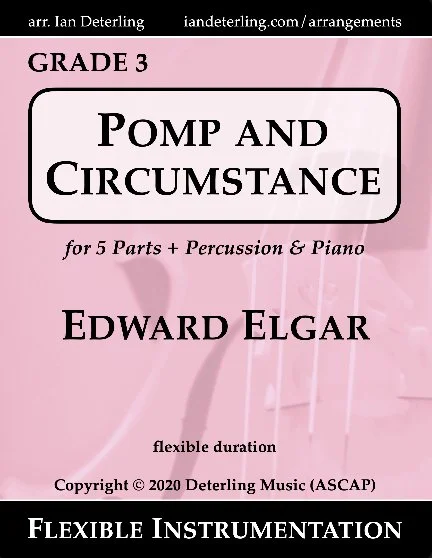
Pomp and Circumstance (Edward Elgar)
Instrumentation: flexible (5 Parts + Percussion & Piano)
Level: Grade 3
Duration: flexible
Key Signature: concert Bb Major


Score/Parts PDF Previews
Only selected pages of the score/parts are available for preview.
Notes
Composed by Edward Elgar, arranged by Ian Deterling.
OVERVIEW
This arrangement of Pomp and Circumstance was created with flexibility, endurance, and practicality in mind - particularly for graduation ceremonies and other extended or variable-length performances. It is designed to accommodate a wide range of ensemble sizes, instrumentations, and performance demands while remaining stylistically faithful to the original work.
FORM AND PERFORMANCE FLEXIBILITY
With the exception of a short introduction and concluding coda, the arrangement consists of four modular 20-measure sections. Sections [1] and [4] present the familiar melody over a traditional pulsing accompaniment. Sections [2] and [3] follow the same harmonic progression but incorporate the primary thematic material in varied ways, including segmentation, inversion, and reversal. These sections provide musical variety while also allowing players measures of rest to preserve endurance during long performances. Each section is clearly labeled in the score as [1], [2], [3], and [4], with the coda labeled [5]. From any section, the ensemble may proceed directly to the coda if directed. Additionally, any section may transition seamlessly into any other section, allowing sections to be repeated, skipped, or reordered as needed. This system allows the conductor to control the form in real time - simply by indicating the next desired section - making the arrangement ideal for performances of unpredictable or extended length.
INSTRUMENTATION AND SCORE LAYOUT
The arrangement is written in five primary parts plus percussion and piano, with each part available for performance by a variety of instruments. To maintain score clarity and readability, only the most commonly used band instruments are shown in the full score. Less common instruments are fully supported and available as individual parts but may not appear in the score. This approach was chosen intentionally to reduce visual clutter and improve rehearsal efficiency, with the understanding that most performances will primarily utilize standard band instrumentation.
INSTRUMENT LIST AND FILE INDEX
All individual parts are available as separate PDF files, along with the full score (when purchased directly from iandeterling.com). To make locating individual parts easier, each instrument in the list is assigned a unique index number. This number corresponds to the numbered PDF file. For example, if you want Alto Saxophone (Part 4), find it in the instrument list and note its index number (e.g., 39). Then, locate the PDF file that has that number - files are organized in numerical order, so you can quickly access the correct part without searching through each file individually .
Note: Purchasers from other distributors may receive all parts in a single PDF file; the index numbers only correspond to the separate PDFs available via this website.
INSTRUMENT LIST
Part 1:
C: Flute; Oboe; Trumpet in C; Violin
Bb: Clarinet in Bb; Trumpet in Bb; Soprano Saxophone
Eb: Clarinet in Eb; Alto Clarinet; Alto Saxophone
Part 2:
C: Flute; Oboe; Trumpet in C; Guitar; Violin
Bb: Clarinet in Bb; Trumpet in Bb; Soprano Saxophone
Eb: Alto Clarinet; Alto Saxophone
F: English Horn
Part 3:
C: Alto Trombone; Guitar; Viola
Bb: Clarinet in Bb; Tenor Saxophone
Eb: Alto Clarinet; Alto Saxophone
F: Horn in F
Part 4:
C: Bassoon; Trombone; Euphonium; Guitar; Cello
Bb: Clarinet in Bb; Bass Clarinet; Tenor Saxophone; Euphonium T.C.
Eb: Alto Clarinet; Alto Saxophone
F: Basset Horn; Horn in F
Part 5:
C: Bassoon; Trombone; Bass Trombone; Euphonium; Tuba; Guitar; Cello; Contrabass
Bb: Bass Clarinet; Contrabass Clarinet; Euphonium T.C.; Bass (Tuba) in Bb T.C.
Eb: Contra Alto Clarinet; Baritone Saxophone; Bass (Tuba) in Eb T.C.
F: Basset Horn
Percussion:
Snare Drum
Bass Drum
Cymbals (Crash Cymbals; Suspended Cymbals)
Mallet Percussion
Timpani (two drums)
Piano
Note: this arrangement has been transposed into the key of concert Bb Major (the original is in G Major).
What do I get when I order Pomp and Circumstance?
You will receive the full score and a complete set of parts as individual PDF files
Score formatted to Tabloid paper, 11” x 17” (279mm x 432mm)
Score formatted to US Letter-size paper, 8.5” x 11” (216mm x 279mm)
Complete set of parts
Once your order has been processed, you’ll be emailed a link where you can download the sheet music.
When you click on the link to download your music, you’ll be brought to the download page (see image)
Note that the score and parts are separated into different PDF files.
You can download everything (‘Download All’ button at the bottom), save the files to Dropbox, or download selected score/parts individually.
My website is set to five download attempts (see ‘5 downloads remaining’ in the image). If an error occurs or if you need additional download attempts, contact me here and I’ll reset the limit for you.
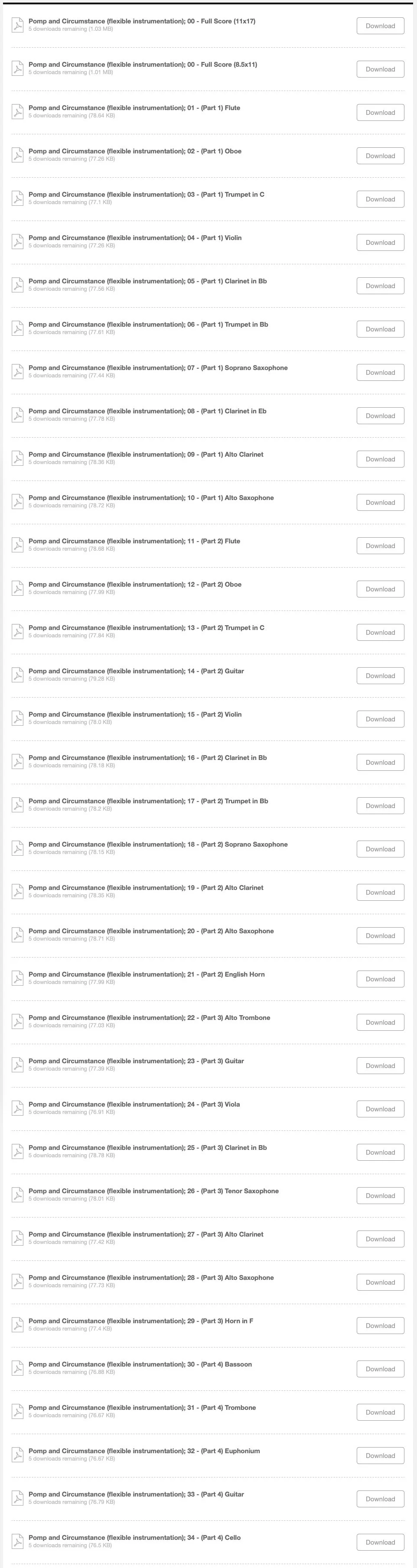
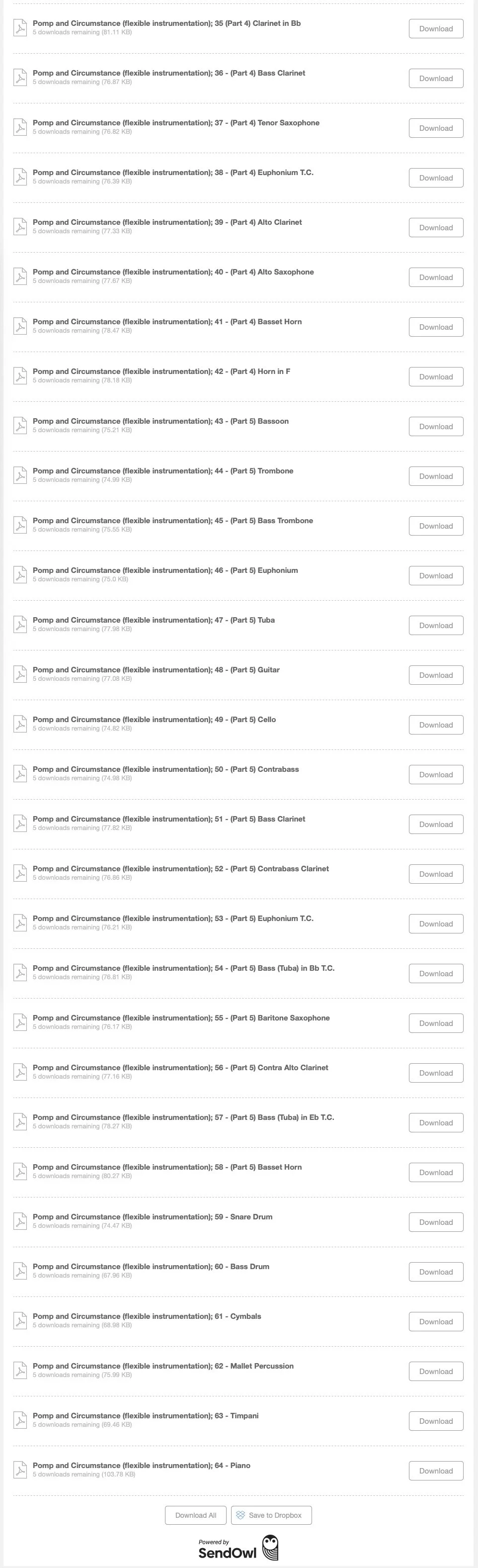
Download page for Pomp and Circumstance